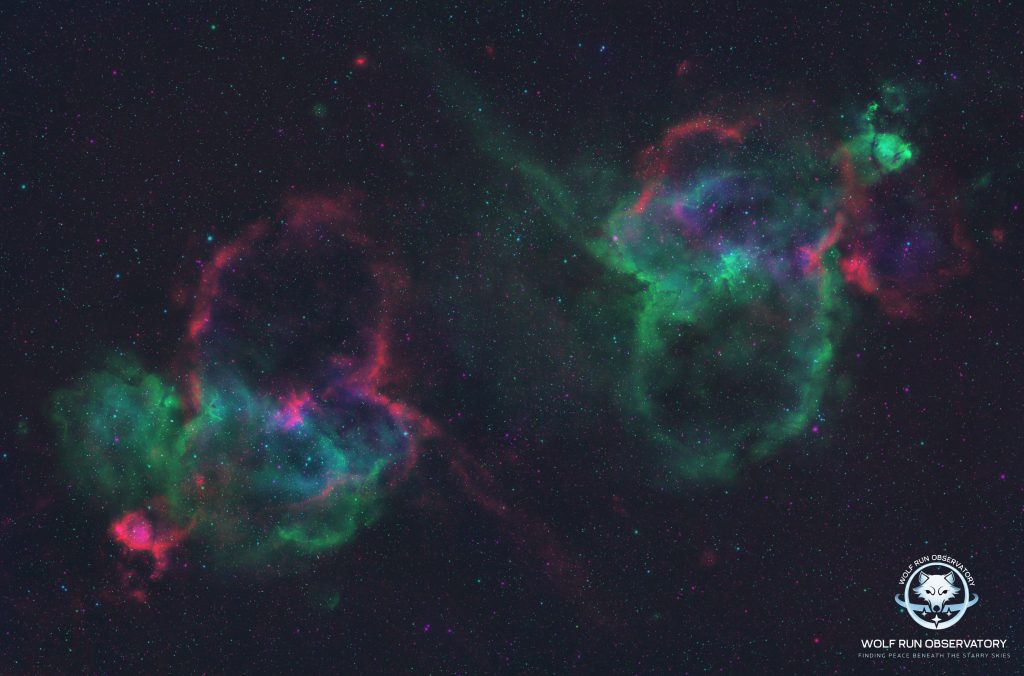
Photographed by Ken Lovely (Cosmic Ken) – Wolf Run Observatory
About the Heart and Soul Nebulae
The Heart and Soul Nebulae are two immense emission nebulae located approximately 7,500 light-years from Earth in the constellation Cassiopeia. Situated within the Perseus Spiral Arm of our Milky Way galaxy, these neighboring clouds of glowing gas and interstellar dust are among the most fascinating regions of active star formation in the northern night sky.
The Heart Nebula (IC 1805) gets its name from its distinctive heart-shaped appearance. Near its center lies Melotte 15, a young open star cluster containing massive, hot stars whose intense ultraviolet radiation causes the surrounding hydrogen gas to glow. Stellar winds and radiation from these stars have sculpted the surrounding clouds into intricate pillars and cavities.
The Soul Nebula, commonly designated IC 1848 and also known as Westerhout 5 (W5), lies alongside the Heart Nebula. It contains several young star clusters and enormous cavities carved into the surrounding gas by generations of massive stars.
Both nebulae contain regions where new stars are forming, making this beautiful pairing an excellent example of stellar birth and evolution within our galaxy.
Together, the Heart and Soul Nebulae span several degrees of the night sky, making them an ideal target for wide-field astrophotography.
Object Information
Common Name: Heart and Soul Nebulae
Object Designations: IC 1805 and IC 1848
Other Designations: Sh2-190, Sh2-199, Westerhout 4 (W4) and Westerhout 5 (W5)
Constellation: Cassiopeia
Object Type: Emission Nebulae / H II Regions
Distance from Earth: Approximately 7,500 light-years
Heart Nebula Dimensions: Approximately 150 × 150 arcminutes
Soul Nebula Dimensions: Approximately 150 × 75 arcminutes
Combined Apparent Extent: Approximately 4 degrees
Combined Physical Extent: Approximately 500 light-years
Associated Star Clusters: Melotte 15, IC 1805 and IC 1848
Galactic Location: Perseus Spiral Arm
Heart Nebula Right Ascension (J2000): Approximately 02h 32m
Heart Nebula Declination (J2000): Approximately +61° 27′
Soul Nebula Right Ascension (J2000): Approximately 02h 51m
Soul Nebula Declination (J2000): Approximately +60° 24′
Best Imaging Season: September through January in Pennsylvania
Visibility: Circumpolar from Wolf Run Observatory
What to Look For in the Image
The Heart Nebula: The distinctive heart-shaped cloud of glowing gas is one of the most recognizable emission nebulae in the northern sky.
Melotte 15: Located near the center of the Heart Nebula, this young star cluster contains massive stars responsible for illuminating and sculpting the surrounding gas and dust.
The Soul Nebula: The neighboring emission nebula contains enormous cavities surrounded by glowing walls of interstellar material.
Pillars of Gas and Dust: Throughout both nebulae, dense concentrations of material resist the radiation and stellar winds from nearby massive stars, creating intricate structures where new stars may form.
The Golden and Blue Nebulosity: This photograph uses the Hubble SHO color palette to represent emissions from ionized sulfur, hydrogen and oxygen. The different colors help distinguish the distribution and structure of these elements.
Dark Dust Structures: Dark regions throughout the image are concentrations of interstellar dust that obscure the light emitted by the surrounding gas.
The Surrounding Nebulosity: Fainter clouds of glowing gas extend beyond the recognizable boundaries of both nebulae, revealing that they are part of a much larger star-forming complex.
Did You Know?
The light captured in this photograph began its journey toward Earth approximately 7,500 years ago.
At that time, early agricultural communities were developing throughout parts of Europe, Asia and Africa. Stonehenge had not yet been constructed, and the Great Pyramid of Giza was still thousands of years away from being built.
Another fascinating aspect of this photograph is its color palette. Rather than reproducing the colors as they might appear to the human eye, the image assigns different colors to light emitted by three chemical elements:
Red: Singly ionized sulfur (SII)
Green: Hydrogen-alpha (Ha)
Blue: Doubly ionized oxygen (OIII)
This technique is commonly known as the Hubble Palette, or SHO, and has been used in many iconic astronomical photographs produced by the Hubble Space Telescope.
By separating these emissions, astrophotographers can reveal structures and relationships within nebulae that might otherwise be difficult to distinguish.
The Wolf Run Journey
The Heart and Soul Nebulae represent an important milestone in my astrophotography journey at Wolf Run Observatory.
This project marked the introduction of my new portable imaging system, consisting of a William Optics RedCat 51 WIFD refractor, a ZWO AM3 harmonic drive mount and a ZWO ASI2600MC Duo imaging camera.
With its 250 mm focal length, the RedCat provides a considerably wider field of view than my other telescopes, allowing me to photograph both the Heart and Soul Nebulae together in a single frame without creating a mosaic.
This project was also an opportunity to explore SHO narrowband imaging without purchasing a dedicated monochrome camera and filter wheel.
Using two Askar dual-band filters, I collected data representing hydrogen-alpha, sulfur and oxygen emissions. One filter captures hydrogen-alpha and oxygen, while the other captures sulfur and oxygen.
Although my imaging camera is a one-shot color camera, separating and combining the individual color channels in PixInsight allowed me to construct independent master images representing these three emissions.
Of course, no major Wolf Run project would be complete without a technical challenge or two.
During preprocessing, PixInsight failed to produce one of the blue-channel master images from my sulfur and oxygen dataset. Rather than discard the data, I investigated the problem and discovered that 127 registered blue-channel images were available. I was able to manually integrate these images and recover the missing master.
With the necessary master images available, I used PixelMath to construct the individual hydrogen, sulfur and oxygen images before beginning the SHO color composition.
Processing this image was a considerably different experience from processing a conventional color astrophotograph. Instead of simply adjusting the colors captured by the camera, I was working with separate emission signals and deciding how best to represent their structures and relationships.
This project was as much about learning a new imaging and processing technique as it was about photographing two beautiful nebulae.
It also demonstrated the capabilities of my new portable imaging system and opened the door to many more wide-field astrophotography projects.
My Imaging Setup
Observatory: Wolf Run Observatory
Location: Upper Pottsgrove, Pennsylvania, USA
Imaging System: Astro3 – A dedicated Windows 11 mini PC configured for portable astrophotography
Telescope: William Optics RedCat 51 WIFD
Optical Design: Petzval Refractor
Aperture: 51 mm
Focal Length: 250 mm
Focal Ratio: f/4.9
Mount: ZWO AM3 Harmonic Drive Equatorial Mount
Imaging Camera: ZWO ASI2600MC Duo
Camera Sensor: Sony IMX571 APS-C CMOS
Sensor Resolution: 6248 × 4176 pixels
Pixel Size: 3.76 μm
Guiding Camera: Integrated guiding sensor of the ASI2600MC Duo
Filters: Askar Color Magic C1 (Ha + OIII) and C2 (SII + OIII)
Acquisition Software: N.I.N.A.
Guiding Software: PHD2
Plate Solving Software: ASTAP
Image Processing Software: PixInsight
Acquisition Details
Imaging Period: November 2026
Exposure Duration: 180 seconds
Acquisition Type: Dual-band narrowband imaging
Hydrogen and Oxygen Acquisition: Askar Color Magic C1
Sulfur and Oxygen Acquisition: Askar Color Magic C2
Camera Gain: 100
Camera Offset: 50
Camera Temperature: −10°C
Binning: 1 × 1
Dithering: Every 3 exposures
Camera Rotation: 50° acquisition framing
Native Field of View: Approximately 5.38° × 3.60°
Native Image Scale: Approximately 3.10 arcseconds per pixel
Color Palette: SHO – Hubble Palette
Mosaic: No – Single Field of View
Image Processing
The image was processed using PixInsight, with a combination of narrowband channel extraction, mathematical image combination and specialized astrophotography processing tools.
Weighted Batch Preprocessing (WBPP): Calibration, registration and integration of the individual exposures acquired using both dual-band filters.
Channel Separation: Extraction of the individual red, green and blue channels from the dual-band datasets to isolate the hydrogen, sulfur and oxygen emissions.
Manual Image Integration: Recovery of a missing blue-channel master image by manually integrating 127 registered light frames.
PixelMath: Construction of independent Ha, SII and OIII master images. Oxygen data from both dual-band filters was combined to create a common OIII master.
BlurXTerminator: Correction of optical blur and improvement of fine structural detail within the nebulae.
NoiseXTerminator: Reduction of image noise while preserving delicate emission structures.
StarXTerminator: Separation of stellar and nebular components, allowing the stars and nebulosity to be processed independently.
Generalized Hyperbolic Stretch (GHS): Controlled stretching of the narrowband data to reveal faint nebulosity and establish contrast.
ChannelCombination: Assignment of the sulfur, hydrogen and oxygen master images to the red, green and blue color channels to construct the SHO color image.
Curves Transformation: Refinement of brightness, contrast, saturation and color relationships within the SHO composition.
The primary objective throughout processing was to reveal the intricate structures of both nebulae while maintaining depth within the darker regions and preserving the faint surrounding emission.
This project demonstrated that a one-shot color camera, when paired with appropriate dual-band filters and careful image processing, can produce an SHO image without requiring a dedicated monochrome imaging system.
References and Further Reading
- Wikipedia – Heart Nebula
- Wikipedia – Soul Nebula
- SIMBAD Astronomical Database – IC 1805
- SIMBAD Astronomical Database – IC 1848
- NASA Astronomy Picture of the Day
- Wolf Run Observatory on AstroBin
The finished image is the receipt for the journey.