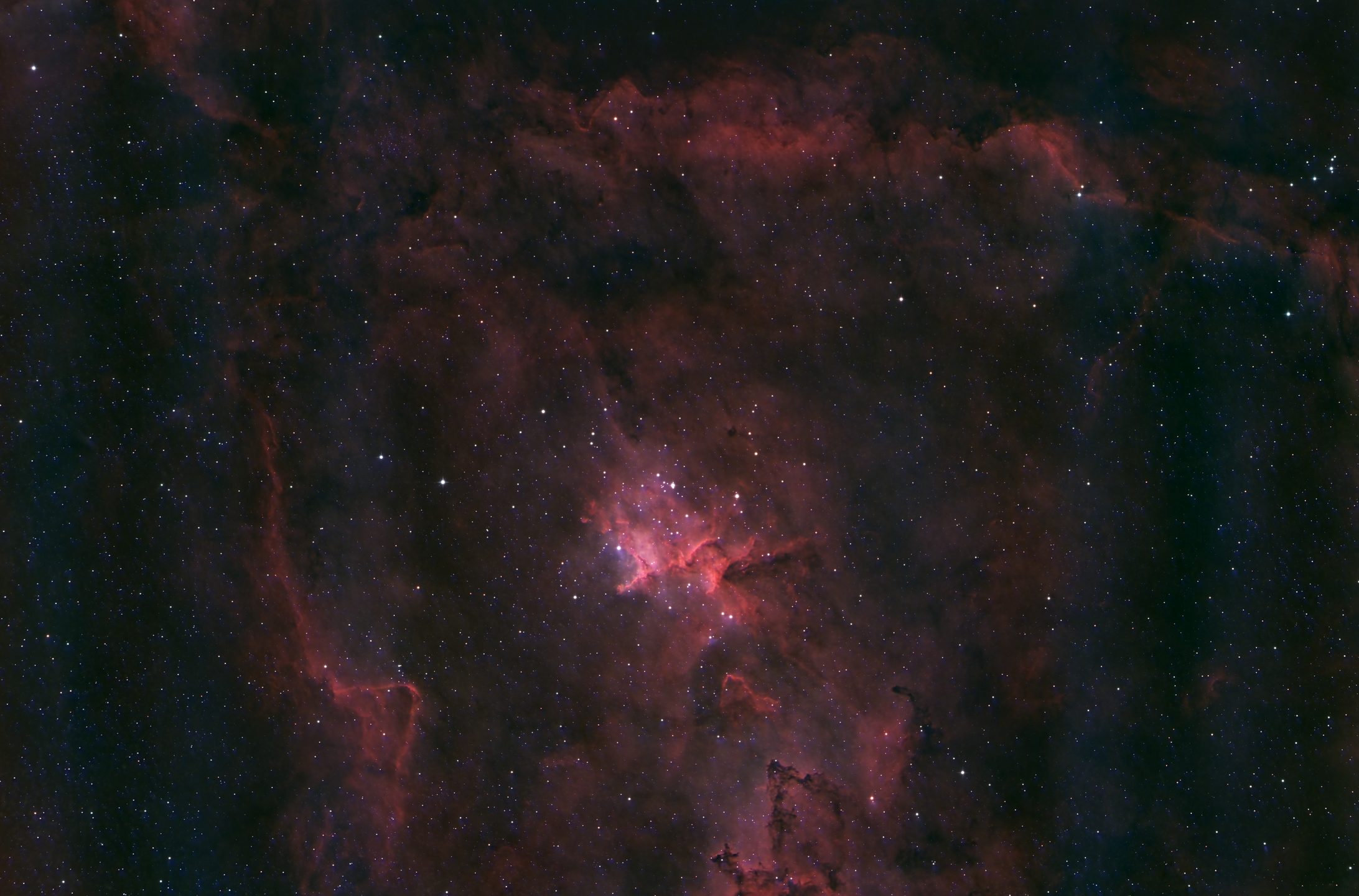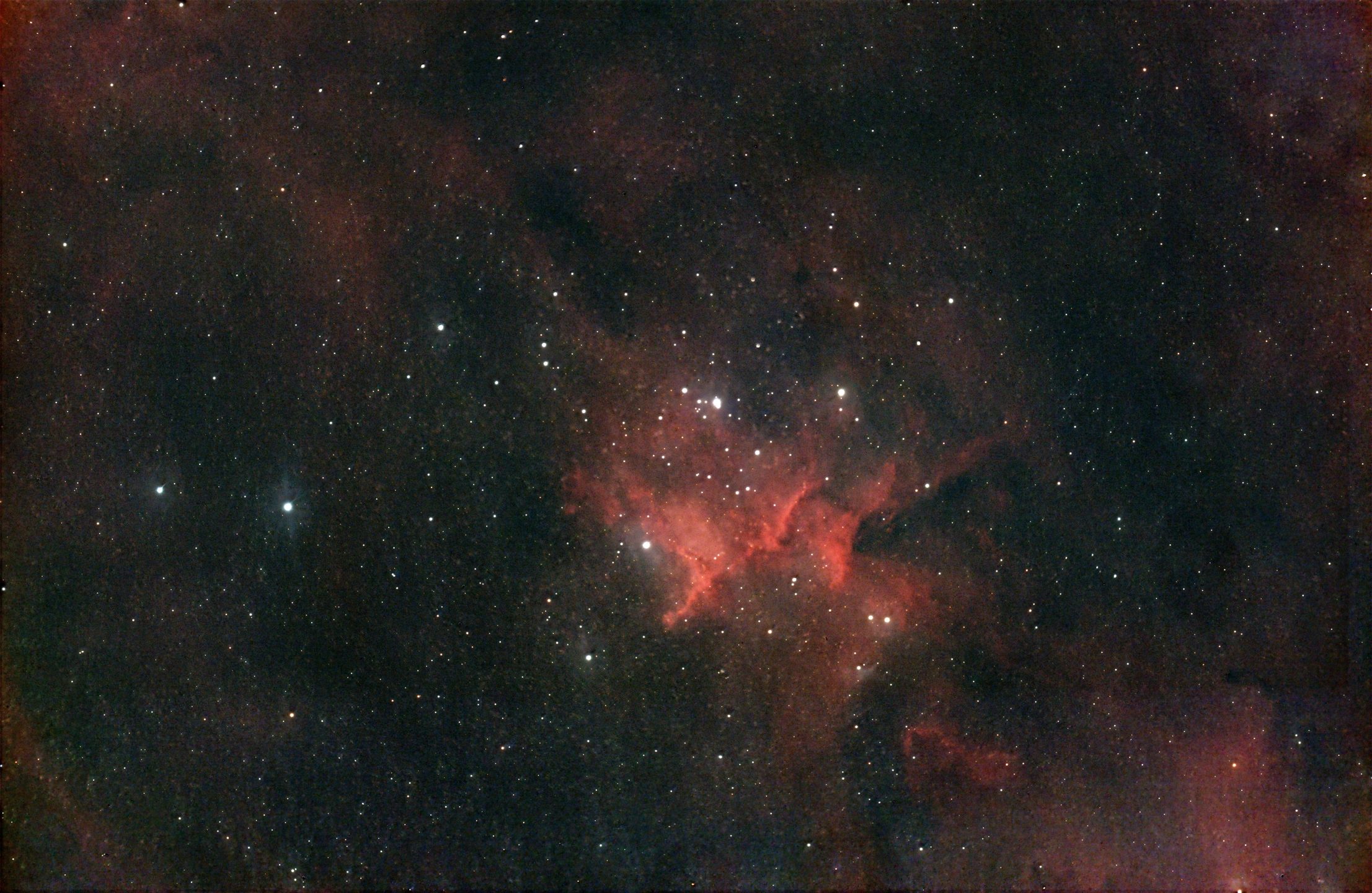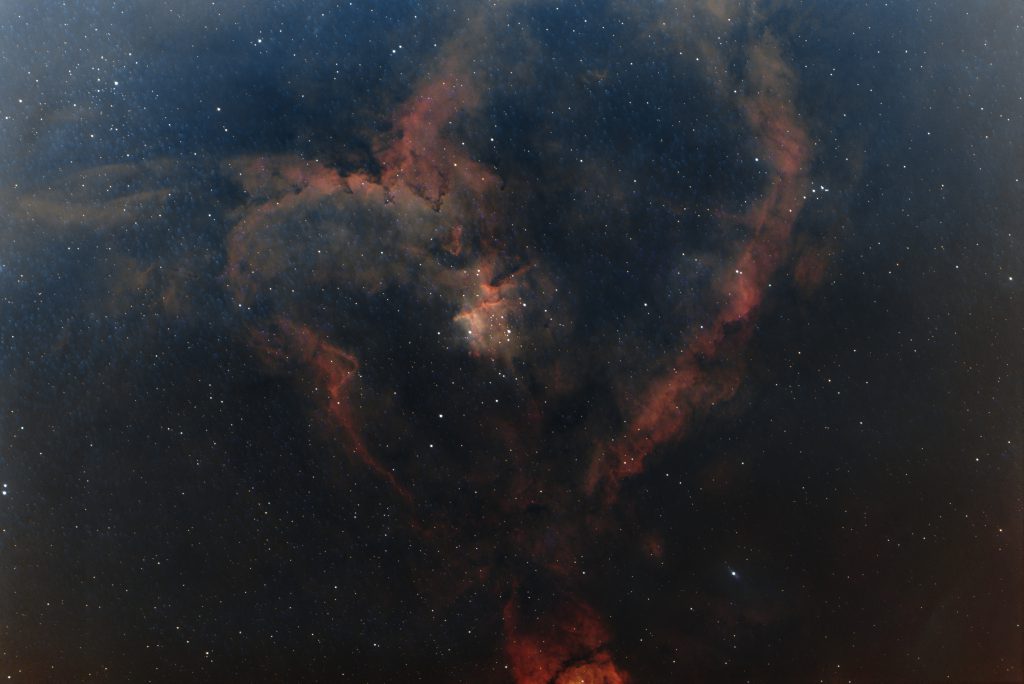
The Heart Nebula (also known as the Running Dog Nebula) is an emission nebula, 7,500 light-years away from Earth and located in the Perseus Arm of the Galaxy in the constellation Cassiopeia. It was discovered by William Herschel in 1787. It displays glowing ionized hydrogen gas and darker dust lanes.
They say the brightest part of the nebula (a knot at its western edge) is separately classified as NGC 896, because it was the first part of the nebula to be discovered. The nebula’s intense red output and its morphology are driven by the radiation emanating from a small group of hot stars near the nebula’s center. This open cluster of stars, known as Melotte 15, or IC 1805, contains a few bright stars nearly 50 times the mass of the Sun, and many more dim stars that are only a fraction of the Solar mass.
I imaged this with 3 different telescopes to get 3 distinct views.
The top image – wide angle:
Telescope: Celestron 9.25 SCT with a Starzona Hyperstar @ 525mm F/2.2
Camera: ZWO ASI2600 MC Pro – L-QEF filter
Mount: Celestron CGEMII using ASCOM Driver
Guiding: SvBony 50mm Guide Scope with a ZWO ASI120MM Camera and PHD2
NINA Imaging Software
The next image – mid angle:
Telescope: Apertura CarbonStar 200 Imaging Newtonian 800mm / F4
Camera: ZWO ASI2600 MC Pro – Antlia RGB Ultra Filter
Mount: Celestron AVX using ASCOM Driver
Guiding: Apertura 32mm Guide Scope with a ZWO ASI120MM Camera and PHD2
NINA Imaging Software
The final image – close up:
Telescope: Celestron 9.25 SCT with Starzona .63 reducer @ 1480mm F/6.5
Camera: ZWO ASI2600 MC Pro – L-QEF filter
Mount: Celestron CGEMII using ASCOM Driver
Guiding: SvBony 50mm Guide Scope with a ZWO ASI120MM Camera and PHD2
NINA Imaging Software
Object Designations: None for nebula – IC-1805 for the star cluster
Also known as: Heart Nebula and Running Dog Nebula
Constellation: Cassiopeia
Object Type: emission nebula
Distance: 7,000 light-years away
Magnitude: 6.5
Discovery: William Herschel in 1787
Processing Software
AstroSharp Ltd SharpCap
Pleiades Astrophoto PixInsight
GraXpert
Russell Croman Astrophotography BlurXTerminator
Russell Croman Astrophotography NoiseXTerminator
Russell Croman Astrophotography StarXTerminator
Various scripts
ChatGPT to help with my color-blindness
General PixInsight Workflow
Not bad for a Color Blind Guy. I go for natural color.
WBPP, I use Bias Frames, Dark Frames, and Flat Frames
GrapXert, Crop, Background Extraction (defaults), Save Processed
BlurExterminator (defaults)
SPCC (defaults)
NoiseXTerminator (defaults)
StarXTerminator (defaults)
GHS – set BP, stretch to see structure, small stretches – Never over stretch, always under stretch
LHE – if needed
Curves – Small Saturation – if needed, also RGB/K – in needed – Never over do it, under do it
GHS to stars, This is an art. I like to push them so get the colors, while maintainng stability
PixMath – Image+Stars*.7 dim the stars to suite your style with the percentage
This final images:
Top Image – Hyperstar: 203 – 120 second subs at 100 gain, L-QEF (2 days of imaging in full moon)
Mid Image – Carbonstar: 129 – 300 second subs at 100 gain, L-QEF (3 days of imaging in full moon)
Bottom Image – .63 Reducer: 224 – 300 second subs at 100 gain, L-QEF (3 days of imaging in full moon)