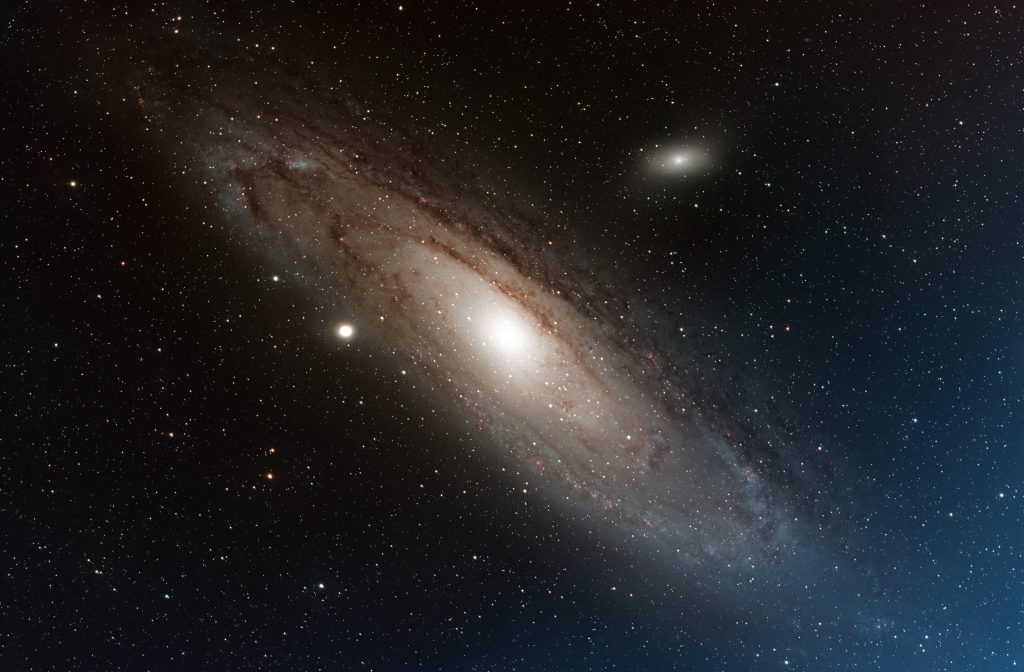
I LOVE imaging this galaxy. Considering how far I have come since I started imaging this beauty. Below are all the images I have taken of M31 through the years.
The Andromeda Galaxy is a barred spiral galaxy and is the nearest major galaxy to the Milky Way. It was originally named the Andromeda Nebula and is cataloged as Messier 31, M31, and NGC 224. The galaxy’s name stems from the area of Earth’s sky in which it appears, the constellation of Andromeda, which itself is named after the princess who was the wife of Perseus in Greek mythology.
The virial mass of the Andromeda Galaxy is of the same order of magnitude as that of the Milky Way, at 1 trillion solar masses (2.0×1042 kilograms). The mass of either galaxy is difficult to estimate with any accuracy, but it was long thought that the Andromeda Galaxy was more massive than the Milky Way by a margin of some 25% to 50%. However, this has been called into question by early-21st-century studies indicating a possibly lower mass for the Andromeda Galaxy and a higher mass for the Milky Way. The Andromeda Galaxy has a diameter of about 46.56 kpc (152,000 ly), making it the largest member of the Local Group of galaxies in terms of extension.
The top image – 2026:
(3 nights, Sept 5-8, 750 60 second sub frames )
Telescope: Celestron 9.25 SCT with a Starzona Hyperstar @ 525mm F/2.2
Camera: ZWO ASI2600 MC Pro – L-QEF filter
Mount: Celestron CGEMII using ASCOM Driver
Guiding: SvBony 50mm Guide Scope with a ZWO ASI120MM Camera and PHD2
NINA Imaging Software
Object Designations: Messier 31, M31, and NGC 224
Also known as: Andromeda Galaxy
Constellation: Andromeda
Object Type: barred spiral galaxy
Distance: 2.5 Million light-years away
Magnitude: 3.4
Discovery: Abd al-Rahman al-Sufi om 903
Processing Software
AstroSharp Ltd SharpCap
Pleiades Astrophoto PixInsight
GraXpert
Russell Croman Astrophotography BlurXTerminator
Russell Croman Astrophotography NoiseXTerminator
Russell Croman Astrophotography StarXTerminator
Various scripts
ChatGPT to help with my color-blindness
General PixInsight Workflow
Not bad for a Color Blind Guy. I go for natural color.
WBPP, I use Bias Frames, Dark Frames, and Flat Frames
GrapXert, Crop, Background Extraction (defaults), Save Processed
BlurExterminator (defaults)
SPCC (defaults)
NoiseXTerminator (defaults)
StarXTerminator (defaults)
GHS – set BP, stretch to see structure, small stretches – Never over stretch, always under stretch
LHE – if needed
Curves – Small Saturation – if needed, also RGB/K – in needed – Never over do it, under do it
GHS to stars, This is an art. I like to push them so get the colors, while maintaining stability
PixMath – Image+Stars*.7 to dim the stars to suite my style with the percentage
Below are all the different times I have imaged Adromeda since 2024.
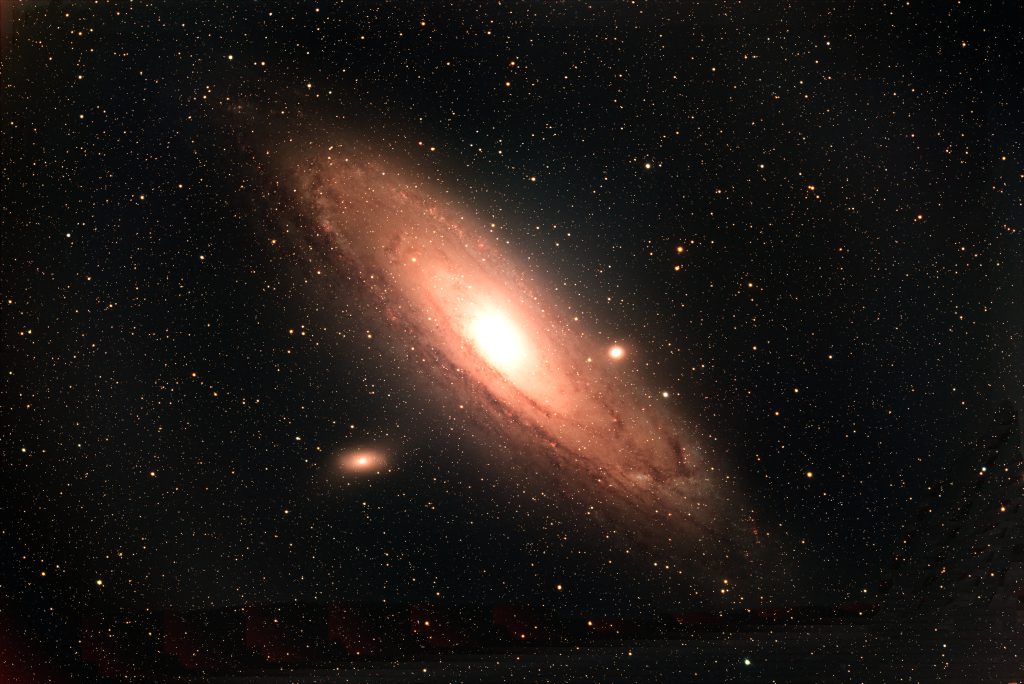
Above image – 2024:
(1 night, Oct 27, 188 180 second sub frames ) – Looking closely, you can see the light pollution I was not able to clean up in PixInsight.
Telescope: Celestron 8 SCT with a Starzona Hyperstar @ 480mm F1.9
Camera: ZWO ASI2600 MC Pro – Antilia RGB Ultra Filter
Mount: Celestron AVX using CPWI
Guiding: Celestron StarSense Autoguider
SharpCap Imaging Software
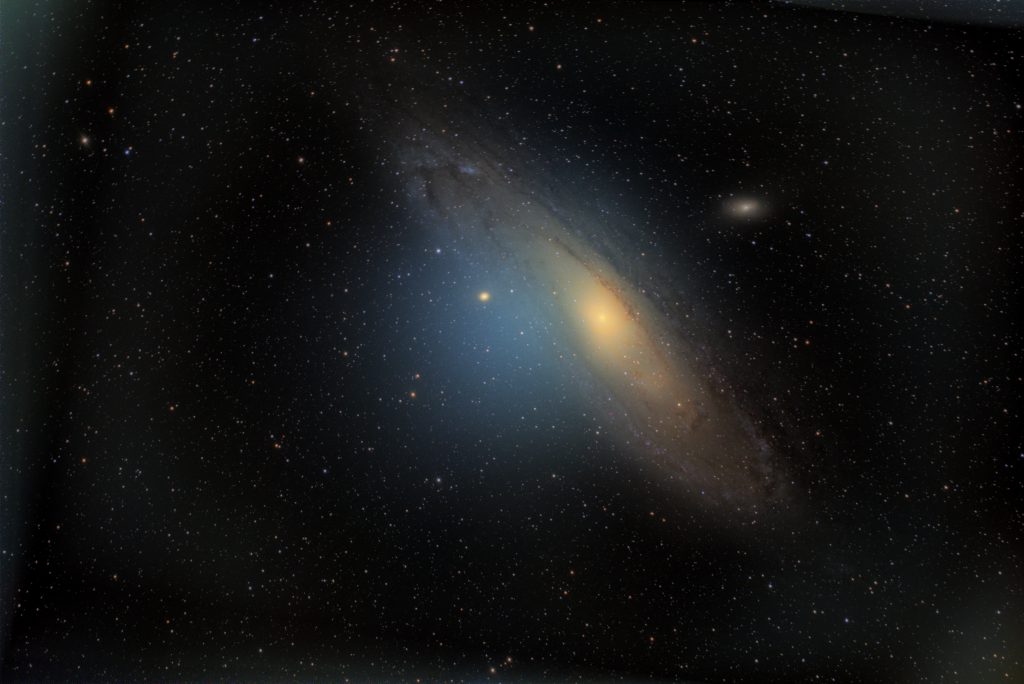
Above image – 2023:
(1 night, Septeptember 12th , 630 15 second sub frames ) –
Telescope: Celestron 8 SCT with a Starzona Hyperstar @ 480mm F1.9
Camera: ZWO ASI2600 MC Pro – No filter
Mount: Celestron AVX using CPWI
Guiding: Celestron StarSense Autoguider
SharpCap Imaging Software
This one I took in November 2023 with my Cannon EOS M100 using Backyard EOS.