Photographed by Ken Lovely (Cosmic Ken) – Wolf Run Observatory
About the Pacman Nebula
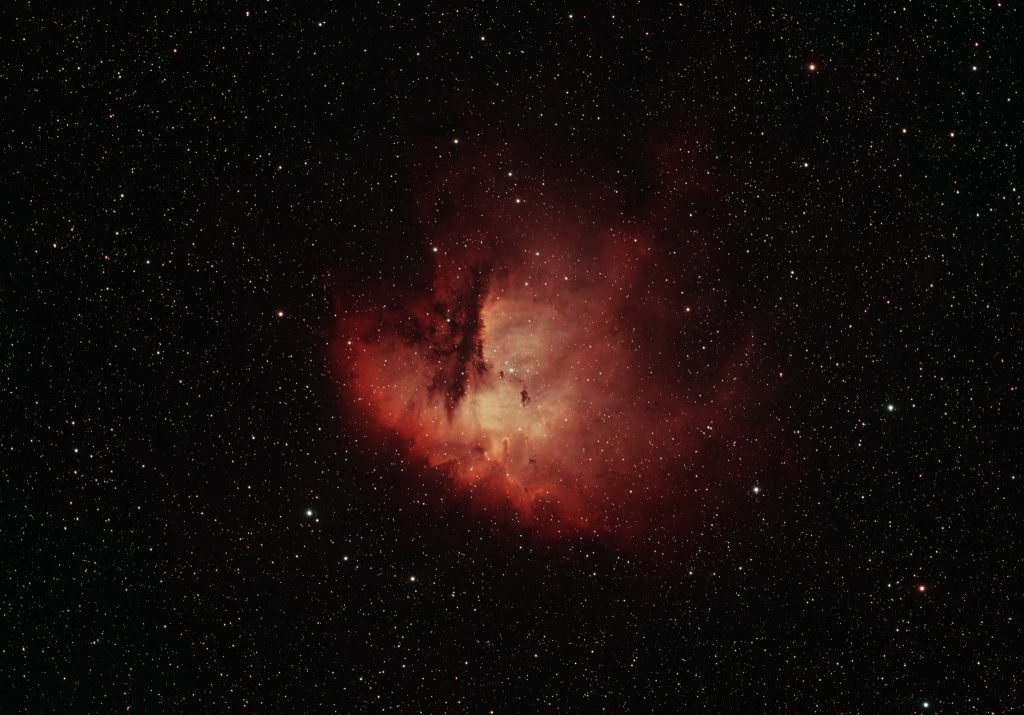
The Pacman Nebula (NGC 281) is an emission nebula located approximately 9,200 light-years from Earth in the constellation Cassiopeia. Located within the Perseus Spiral Arm of our Milky Way galaxy, this immense cloud of glowing gas and interstellar dust is an active stellar nursery where new stars are forming.
The nebula gets its nickname from its resemblance to the famous Pac-Man video game character. Its distinctive mouth is created by dense clouds of interstellar dust that obscure the light emitted by the glowing gas behind them.
Embedded within the nebula is a young open star cluster known as IC 1590. Its massive, hot stars release intense ultraviolet radiation, ionizing the surrounding hydrogen gas and causing it to glow. Radiation and powerful stellar winds from these stars continually reshape the surrounding clouds, creating intricate structures of gas and dust.
The Pacman Nebula is a fascinating example of the ongoing cycle of star formation within our galaxy.
Object Information
Common Name: Pacman Nebula
Object Designation: NGC 281
Other Designations: IC 11, Sh2-184, LBN 616
Constellation: Cassiopeia
Object Type: Emission Nebula / H II Region
Distance from Earth: Approximately 9,200 light-years
Apparent Magnitude: 7.4 (commonly cataloged value)
Apparent Dimensions: 35 × 30 arcminutes
Physical Diameter: Approximately 90 light-years
Associated Star Cluster: IC 1590
Galactic Location: Perseus Spiral Arm
Discovered By: Edward Emerson Barnard
Discovery Year: 1881
Right Ascension (J2000): 00h 52m 59s
Declination (J2000): +56° 37′ 19″
Best Imaging Season: September through December in Pennsylvania
What to Look For in the Image
The Pacman Mouth: The distinctive dark opening that gives the nebula its familiar shape is formed by interstellar dust obscuring the glowing gas.
Bok Globules: Small, dense concentrations of gas and dust appear as dark structures silhouetted against the brighter nebulosity. These regions may contain the raw materials for the formation of new stars.
The Central Star Cluster: IC 1590 contains the young, energetic stars responsible for illuminating much of the surrounding nebula.
Glowing Hydrogen Gas: Hydrogen-alpha emissions produce the characteristic deep red coloration of the nebula.
Pillars of Gas and Dust: Radiation and stellar winds sculpt the surrounding material into intricate structures, some of which may shelter newly forming stars.
Did You Know?
The light captured in this photograph began its journey toward Earth approximately 9,200 years ago, during a period when early agricultural communities were developing in parts of the world.
Thousands of years later, that light reached my telescope here at Wolf Run Observatory in Upper Pottsgrove, Pennsylvania.
Astrophotography truly is a journey through time.
The Wolf Run Journey
I photographed the Pacman Nebula over two nights in October 2026 using my Celestron C9.25 equipped with the Starizona HyperStar system. Operating at approximately f/2.2, this configuration allows me to collect significant amounts of light in relatively short exposures.
Using the Optolong L-eXtreme F2 dual-band filter, I captured 545 individual 60-second exposures, resulting in more than nine hours of collected light.
During image processing, I experimented with creating a synthetic Hubble-style color palette using the available narrowband data. Although this was an interesting learning experience, I ultimately decided to return to a more natural color presentation.
My goal was to preserve the rich hydrogen emissions, reveal the intricate dark dust structures and maintain a balanced star field without overwhelming the nebula itself.
Sometimes the most valuable lesson in astrophotography is discovering when to stop experimenting and allow the object to tell its own story.
My Imaging Setup
Observatory: Wolf Run Observatory
Location: Upper Pottsgrove, Pennsylvania, USA
Imaging System: Astro1
Telescope: Celestron C9.25 Schmidt-Cassegrain
Aperture: 235 mm (9.25 inches)
Optical Configuration: Starizona HyperStar V4
Focal Length: Approximately 525 mm
Focal Ratio: f/2.2
Mount: Celestron CGEM II
Imaging Camera: ZWO ASI2600MC Pro
Camera Sensor: Sony IMX571 APS-C CMOS
Sensor Resolution: 6248 × 4176 pixels
Pixel Size: 3.76 μm
Filter: Optolong L-eXtreme F2
Acquisition Software: N.I.N.A.
Guiding Software: PHD2
Plate Solving Software: ASTAP
Image Processing Software: PixInsight
Acquisition Details
Imaging Dates: October 17–18, 2026
October 17: 381 × 60-second exposures
October 18: 164 × 60-second exposures
Total Light Frames Captured: 545
Exposure Duration: 60 seconds
Total Exposure Time: 9 hours, 5 minutes
Camera Gain: 100
Camera Offset: 50
Camera Temperature: −10°C
Binning: 1 × 1
Dithering: Every 3 exposures
Native Field of View: Approximately 2.56° × 1.71°
Native Image Scale: Approximately 1.48 arcseconds per pixel
Image Processing
The image was processed using PixInsight and several specialized astrophotography processing tools.
Weighted Batch Preprocessing (WBPP): Calibration, registration and integration of the individual exposures.
GraXpert: Removal of unwanted background gradients while preserving genuine nebulosity.
BlurXTerminator: Correction of optical blur and improvement of fine structural detail within the nebula.
NoiseXTerminator: Reduction of image noise while preserving delicate astronomical structures.
Spectrophotometric Color Calibration (SPCC): Establishment of a calibrated color foundation.
Generalized Hyperbolic Stretch (GHS): Controlled stretching of the image to reveal faint nebulosity and establish contrast.
StarXTerminator: Separation of the stars from the nebulosity, allowing the nebula to be processed independently of the surrounding star field.
Final Image Adjustments: Gentle stretching of the starless image to improve midtone brightness while preserving the dark dust structures and background.
After experimenting with a synthetic SHO color palette, I chose a more natural color interpretation that emphasizes the hydrogen emissions and preserves the dimensional appearance of the nebula.
References and Further Reading
The finished image is the receipt for the journey.