Photographed by Ken Lovely (Cosmic Ken) – Wolf Run Observatory
About the Rotten Fish Nebula
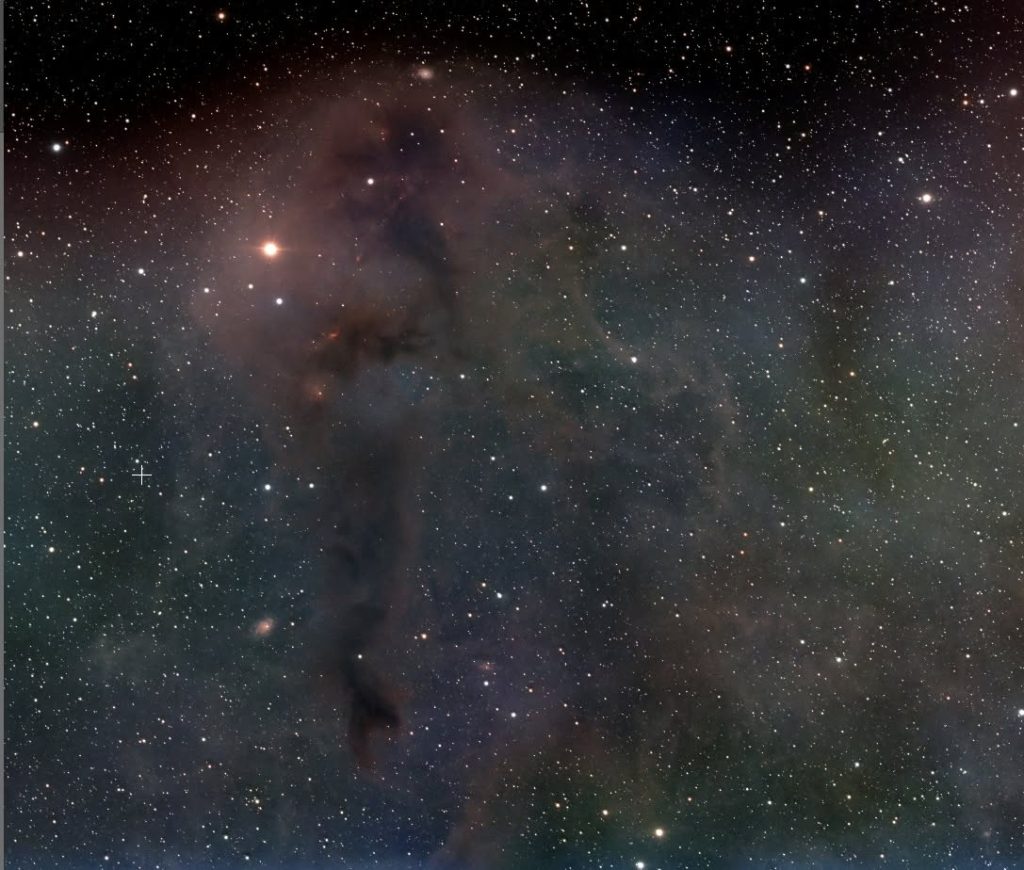
Lynds Dark Nebula 1251 (LDN 1251), commonly known as the Rotten Fish Nebula or Anglerfish Nebula, is a dark molecular cloud located approximately 1,000 light-years from Earth in the constellation Cepheus.
Unlike emission nebulae, which produce their own visible glow through ionized gases, dark nebulae contain dense concentrations of interstellar gas and dust that absorb and scatter light. Their distinctive shapes become visible against the surrounding star field and faintly illuminated dust.
LDN 1251 belongs to a larger collection of molecular clouds known as the Cepheus Flare. Despite its dark appearance, it is an active stellar nursery where new stars are forming within dense concentrations of gas and dust.
Astronomers have identified several Herbig-Haro objects within this region. These small patches of glowing material form when high-speed jets from newly forming stars collide with surrounding interstellar gas.
Distant background galaxies can also be found in this region of the sky, providing a remarkable contrast between the relatively nearby molecular cloud and objects located millions of light-years beyond it.
Object Information
Common Name: Rotten Fish Nebula
Alternate Name: Anglerfish Nebula
Object Designation: LDN 1251 (L1251)
Full Catalog Name: Lynds Dark Nebula 1251
Constellation: Cepheus
Object Type: Dark Nebula / Molecular Cloud
Distance from Earth: Approximately 1,000 light-years
Apparent Magnitude: Not applicable
Apparent Dimensions: Approximately 60 × 30 arcminutes, depending on the defined cloud boundaries
Physical Extent: Approximately 17 light-years across the broader cloud
Opacity Classification: 5 out of 6
Associated Region: Cepheus Flare
Star Formation: Active
Cataloged By: Beverly Turner Lynds
Catalog Publication Year: 1962
Right Ascension (J2000): Approximately 22h 35m
Declination (J2000): Approximately +75° 15′
Best Imaging Season: July through November in Pennsylvania
Visibility: Circumpolar from Wolf Run Observatory
What to Look For in the Image
The Rotten Fish: The elongated concentration of dark dust gives the nebula its unusual fish-like appearance.
Dark Molecular Clouds: The darkest areas represent dense interstellar material blocking the light of more distant stars. These are actual astronomical structures rather than empty regions of space.
Illuminated Dust: Faint brown, gray and blue-gray clouds surrounding the darker structures are created in part by interstellar dust scattering surrounding starlight.
Stellar Nurseries: Hidden within the dense clouds are regions where gravity is drawing gas and dust together to form new stars.
Herbig-Haro Objects: Small reddish patches associated with energetic outflows from young stars can be found within this molecular cloud complex.
Background Galaxies: Extremely distant galaxies lie beyond the molecular clouds, offering a remarkable perspective on the different distances represented within a single region of the night sky.
Did You Know?
The light reaching us from the Rotten Fish Nebula began its journey approximately 1,000 years ago.
Around that time, Norse explorers had reached North America, the Byzantine Empire remained a major world power, and the events leading to the Norman conquest of England were still decades away.
What makes this region particularly fascinating is that some of the material we are observing today may eventually become new stars and planetary systems.
Our own solar system began forming from a cloud of gas and dust approximately 4.6 billion years ago. By photographing regions such as LDN 1251, we are observing the same general processes that ultimately led to the formation of our Sun, Earth and the other planets.
The Wolf Run Journey
The Rotten Fish Nebula was a particularly challenging astrophotography project for me at Wolf Run Observatory.
Unlike brighter emission nebulae, LDN 1251 required extensive exposure time to reveal the extremely faint dust structures surrounding its dark molecular clouds.
I photographed this region over five nights in October 2026 using my Celestron C9.25 equipped with the Starizona HyperStar V4 and an Antlia RGB Ultra filter.
Over those five nights, I collected 1,957 individual exposures totaling 44 hours and 47 minutes of captured light.
Processing this amount of data presented its own challenges. I ultimately combined eight master images to create a single master integration for further processing in PixInsight.
The biggest challenge was revealing the faint surrounding dust without excessively brightening the background, creating artificial contrast or losing the dimensional appearance of the darker structures.
I experimented with different stretching techniques, color adjustments, masks and cropping options before settling on my preferred presentation.
This project demonstrated just how much astronomical detail can be hidden within what initially appears to be an ordinary field of stars.
It also reinforced the importance of patience, both when collecting photons and when processing them.
My Imaging Setup
Observatory: Wolf Run Observatory
Location: Upper Pottsgrove, Pennsylvania, USA
Imaging System: Astro1 – A GMKTEC NUC-style PC with an Intel Core i5 processor, 16 GB RAM and a 1 TB drive
Telescope: Celestron C9.25 Schmidt-Cassegrain
Aperture: 235 mm (9.25 inches)
Optical Configuration: Starizona HyperStar V4
Focal Length: Approximately 525 mm
Focal Ratio: f/2.2
Mount: Celestron CGEM II
Imaging Camera: ZWO ASI2600MC Pro
Camera Sensor: Sony IMX571 APS-C CMOS
Sensor Resolution: 6248 × 4176 pixels
Pixel Size: 3.76 μm
Filter: Antlia RGB Ultra
Acquisition Software: N.I.N.A.
Guiding Software: PHD2
Plate Solving Software: ASTAP
Image Processing Software: PixInsight
Acquisition Details
Imaging Period: October 19–23, 2026
Total Imaging Nights: 5
October 19: 342 × 60 seconds and 84 × 120 seconds (8 hours, 30 minutes)
October 20: 316 × 60 seconds and 97 × 120 seconds (8 hours, 30 minutes)
October 21: 242 × 120 seconds (8 hours, 4 minutes)
October 22: 307 × 120 seconds (10 hours, 14 minutes)
October 23: 569 × 60 seconds (9 hours, 29 minutes)
60-Second Light Frames: 1,227
120-Second Light Frames: 730
Total Light Frames Captured: 1,957
Total Exposure Time: 44 hours, 47 minutes
Combined Master Images: 8
Native Field of View: Approximately 2.56° × 1.71°
Native Image Scale: Approximately 1.48 arcseconds per pixel
Image Processing
The image was processed using PixInsight and several specialized astrophotography processing tools. Particular attention was given to preserving the faint interstellar dust and maintaining natural color relationships.
Image Integration: Eight master images were combined to produce a single master image for further processing.
GraXpert: Background gradient correction to remove unwanted variations in sky brightness while preserving the surrounding dust structures.
ImageSolver: Astronomical plate solving to establish the image’s celestial coordinates and prepare it for photometric color calibration.
Spectrophotometric Color Calibration (SPCC): Establishment of a scientifically calibrated color foundation before making artistic adjustments.
BlurXTerminator: Improvement of structural detail using a restrained nonstellar sharpening setting of 0.35.
NoiseXTerminator: Noise reduction using a denoise setting of 0.65 and one iteration to preserve the delicate dust structures.
Generalized Hyperbolic Stretch (GHS): Controlled stretching to reveal extremely faint nebulosity while maintaining separation between the darker molecular clouds and surrounding illuminated dust.
Masking: Selective processing of different regions to improve contrast without unnecessarily brightening the background.
Curves Transformation: Carefully controlled RGB/K and saturation adjustments to refine brightness, contrast and color relationships.
Final Composition: Experimentation with starless processing, alternate stretches and cropping to emphasize the molecular cloud and its surrounding structures.
My objective throughout processing was to reveal what was already present in the collected data rather than force the image toward a predetermined color palette.
References and Further Reading
- NASA – Lynds Dark Nebula 1251, Astronomy Picture of the Day, July 10, 2025
- NASA – Lynds Dark Nebula 1251, Astronomy Picture of the Day, June 22, 2024
- Wikipedia – Lynds’ Catalogue of Dark Nebulae
- Wolf Run Observatory on AstroBin
The finished image is the receipt for the journey.