Photographed by Ken Lovely (Cosmic Ken) – Wolf Run Observatory
About NGC 925
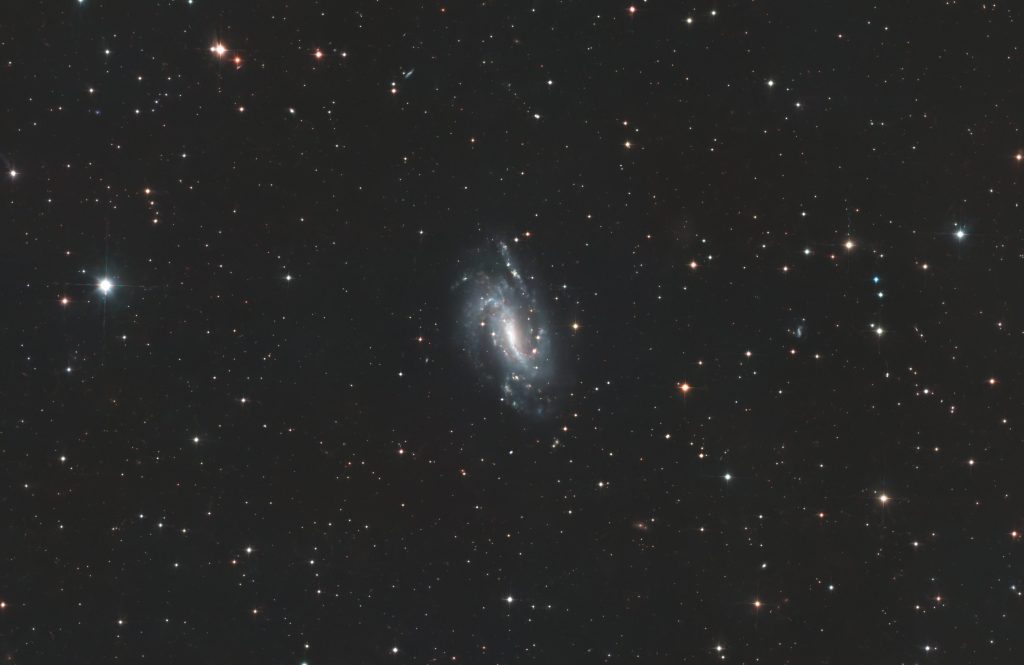
NGC 925 is a barred spiral galaxy located approximately 30 million light-years from Earth in the constellation Triangulum. It belongs to the NGC 1023 Group, a collection of galaxies that also includes the Needle-like Galaxy NGC 891.
Unlike spiral galaxies with a rounded central nucleus, NGC 925 features an elongated central bar of stars from which its loosely wound spiral arms emerge. The galaxy has a somewhat asymmetric appearance, with numerous regions of active star formation scattered throughout its arms.
Young, hot stars give portions of the spiral arms a blue appearance, while clouds of ionized hydrogen produce pockets of pink and red emission. These regions are evidence that the galaxy continues to produce new generations of stars.
Astronomers have also studied Cepheid variable stars within NGC 925 to help determine astronomical distances and better understand the expansion of the universe.
Object Information
Object Designation: NGC 925
Other Designations: UGC 1913, PGC 9332, MCG +05-06-045
Constellation: Triangulum
Object Type: Barred Spiral Galaxy
Galaxy Classification: SAB(s)d
Distance from Earth: Approximately 30 million light-years
Apparent Magnitude: 10.1 (visual)
Apparent Dimensions: Approximately 10.5 × 5.8 arcminutes
Physical Diameter: Approximately 92,000 light-years
Galaxy Group: NGC 1023 Group
Discovered By: William Herschel
Discovery Year: 1784
Right Ascension (J2000): 02h 27m 16.91s
Declination (J2000): +33° 34′ 43.97″
Redshift: 0.001846
Radial Velocity: Approximately 553 km/s
Best Imaging Season: September through January in Pennsylvania
What to Look For in the Image
Central Bar: The elongated concentration of stars passing through the center of the galaxy distinguishes NGC 925 from ordinary spiral galaxies.
Spiral Arms: The loosely wound arms extend outward from the ends of the central bar, giving the galaxy its distinctive asymmetric appearance.
Blue Star-Forming Regions: Concentrations of young, hot stars produce blue areas throughout the spiral arms.
Hydrogen Emission Regions: Small pink and reddish regions mark clouds of ionized hydrogen associated with ongoing star formation.
Interstellar Dust: Dark structures within the galaxy are created by clouds of dust absorbing the light of stars behind them.
Foreground Stars: Most of the individual stars scattered across the surrounding image belong to our own Milky Way galaxy and are considerably closer to Earth than NGC 925.
Did You Know?
The light captured in this photograph began its journey toward Earth approximately 30 million years ago, during a geological period known as the Oligocene Epoch.
Modern humans did not exist. Early elephants were evolving, and some of the ancestors of today’s whales were developing into increasingly specialized marine mammals.
For approximately 30 million years, these photons traveled through intergalactic space before reaching my telescope here at Wolf Run Observatory in Upper Pottsgrove, Pennsylvania.
Every astrophotograph is, in its own way, a photograph of the past.
The Wolf Run Journey
I began photographing NGC 925 in October 2026 using my Apertura CarbonStar 200. With its 800 mm focal length, this telescope provides a good balance between light-gathering capability and image scale for photographing distant galaxies.
Over the first two nights, I collected 458 individual two-minute exposures using my Antlia RGB Ultra filter, totaling 15 hours and 16 minutes of exposure time.
I subsequently collected additional exposures using a UV/IR Cut filter. This provided an opportunity to compare the results from two different filters and experiment with combining their data during image processing.
My processing goals were to reveal the galaxy’s faint spiral arms, preserve its natural color relationships and bring out the finer structures without sacrificing the surrounding background.
My Imaging Setup
Observatory: Wolf Run Observatory
Location: Upper Pottsgrove, Pennsylvania, USA
Imaging System: Astro2
Telescope: Apertura CarbonStar 200 Newtonian Reflector
Aperture: 200 mm (8 inches)
Focal Length: 800 mm
Focal Ratio: f/4
Mount: Celestron Advanced VX (AVX)
Imaging Camera: ZWO ASI2600MC Pro
Camera Sensor: Sony IMX571 APS-C CMOS
Sensor Resolution: 6248 × 4176 pixels
Pixel Size: 3.76 μm
Filters: Antlia RGB Ultra and UV/IR Cut
Acquisition Software: N.I.N.A.
Guiding Software: PHD2
Plate Solving Software: ASTAP
Image Processing Software: PixInsight
Acquisition Details
Imaging Period: October 2026
October 17–18: 194 × 120-second exposures
October 18–19: 264 × 120-second exposures
Antlia RGB Ultra Light Frames: 458
Antlia RGB Ultra Exposure Time: 15 hours, 16 minutes
Additional Acquisition: UV/IR Cut filter, 120-second exposures
Camera Gain: 100
Camera Offset: 50
Camera Temperature: −10°C
Native Field of View: Approximately 1.68° × 1.12°
Native Image Scale: Approximately 0.97 arcseconds per pixel
Image Processing
The image was processed using PixInsight, with particular attention given to combining and comparing data acquired using two different filters.
Weighted Batch Preprocessing (WBPP): Separate preprocessing of the acquisition datasets to evaluate the results from each filter.
PixelMath: Experimentation with combining the Antlia RGB Ultra and UV/IR Cut datasets.
GraXpert: Background gradient correction. A second correction was evaluated but rejected because it produced brighter edges without meaningfully improving the background.
Throughout processing, my objective was to reveal the faint galactic structures while maintaining natural color relationships and a balanced background. Adjustments that did not improve the image were discarded rather than incorporated into the finished photograph.
References and Further Reading
- SIMBAD Astronomical Database – NGC 925
- Wikipedia – NGC 925
- Deep Sky Corner – NGC 925
- Wolf Run Observatory on AstroBin
The finished image is the receipt for the journey.