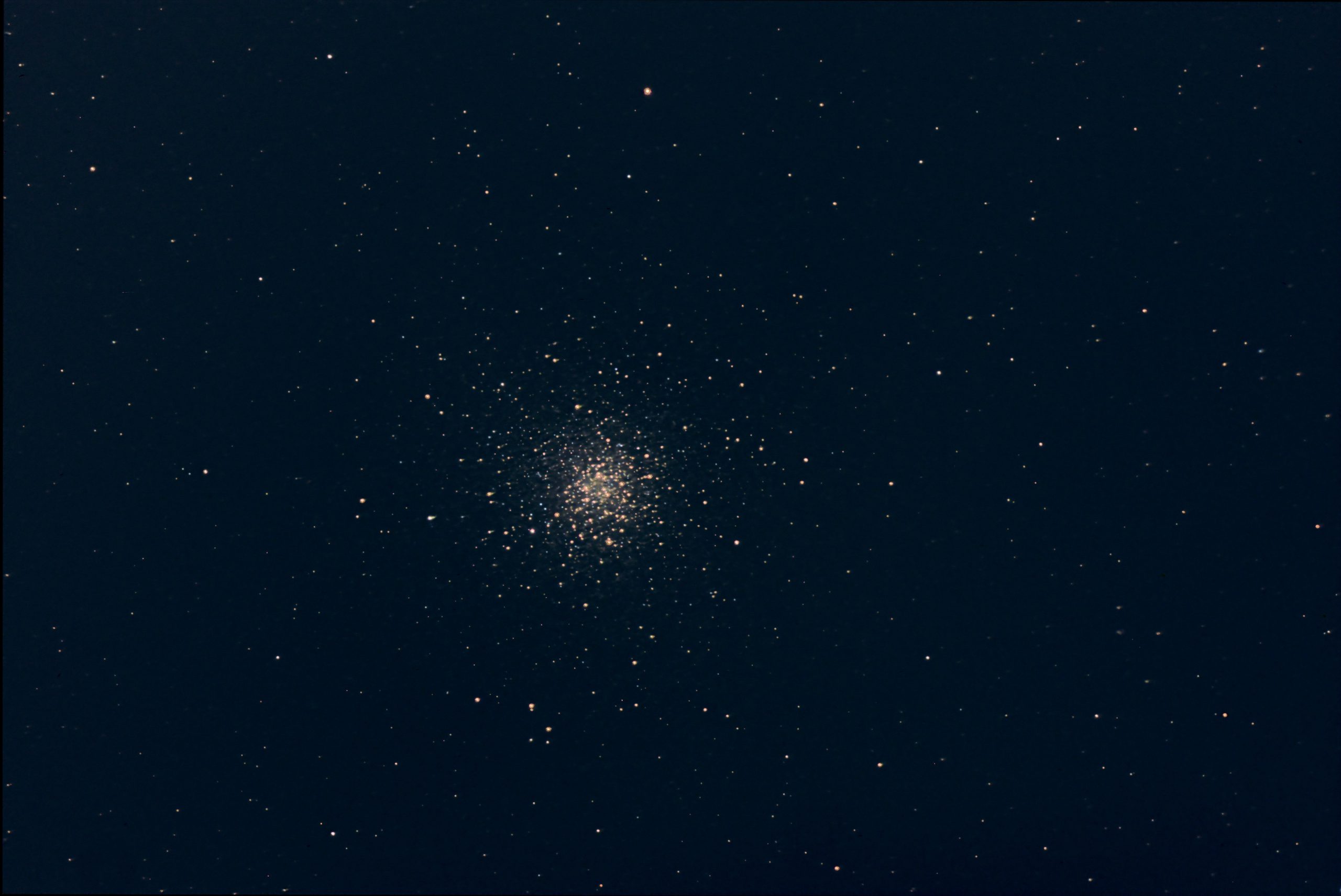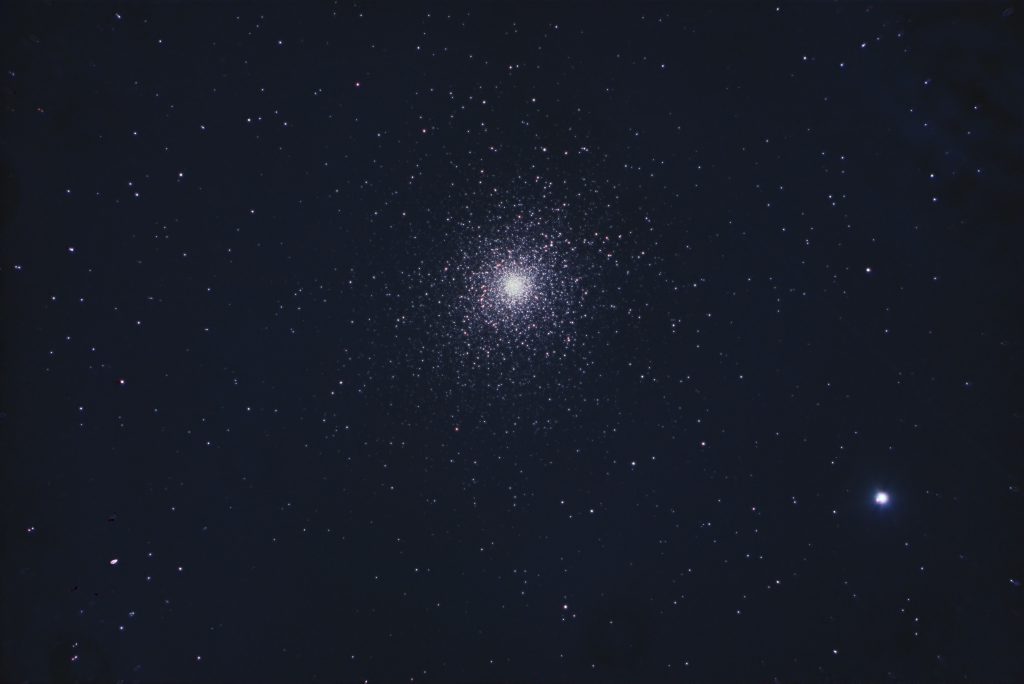
As with most deep space and solar objects, I image multiple times. M10 is no exception. The top image was taken with my CarbonStar 200 and at the bottom of this web page is the one I took with my Celestron 9.25. Besides the difference in the field of view, the color difference is very noticeable. Telling me I am getting better at processing image data in Pixinsight.
Messier 10 or M10 is a globular cluster of stars in the equatorial constellation of Ophiuchus. The object was discovered by the French astronomer Charles Messier on May 29, 1764, who cataloged it as number 10 in his catalogue and described it as a “nebula without stars”. In 1774, German astronomer Johann Elert Bode likewise called it a “nebulous patch without stars; very pale”. Using larger instrumentation, German-born astronomer William Herschel was able to resolve the cluster into its individual members. He described it as a “beautiful cluster of extremely compressed stars”. William Parsons, 3rd Earl of Rosse thought he could distinguish a dark lane through part of the cluster. The first to estimate the distance to the cluster was Harlow Shapley, although his derivation of 33,000 light years was much further than the modern value.
Object Designations: NGC6254, M10, Messier 10
Also known as: (none)
Constellation: Ophiuchus
Object Type: Globular Star Cluster
Distance: 14,000 light-years away
Magnitude: 6.6
Discovery: Charles Messier
The top image 6/10/2026:
Telescope: Apertura CarbonStar 200 Imaging Newtonian 800mm / F4
Camera: ZWO ASI2600 MC Pro – Oplong L-QEF Filter
Mount: Celestron AVX – With CPWI Software
Guiding: Apertura 32mm Guide Scope with a ZWO ASI120MM Camera and PHD2
Imaging Software: SharpCap = 15 60 second subs at 100 gain
LastPlateSolveData: Plate solve result was RA=16:49:10.9,Dec=-04:26:08 with mount at RA=16:49:11.0,Dec=-04:26:08, FOV 1.758×1.175 degrees, up is 269.56 degrees East of North
The image below 4/27/2026:
Telescope: Celestron 9.25 2350 mm / F10
Camera: ZWO ASI2600 MC Pro – No Filter
Mount: Celestron CGEMII – With CPWI Software
Guiding: Celestron Starsense Autoguider
SharpCap Imaging Software