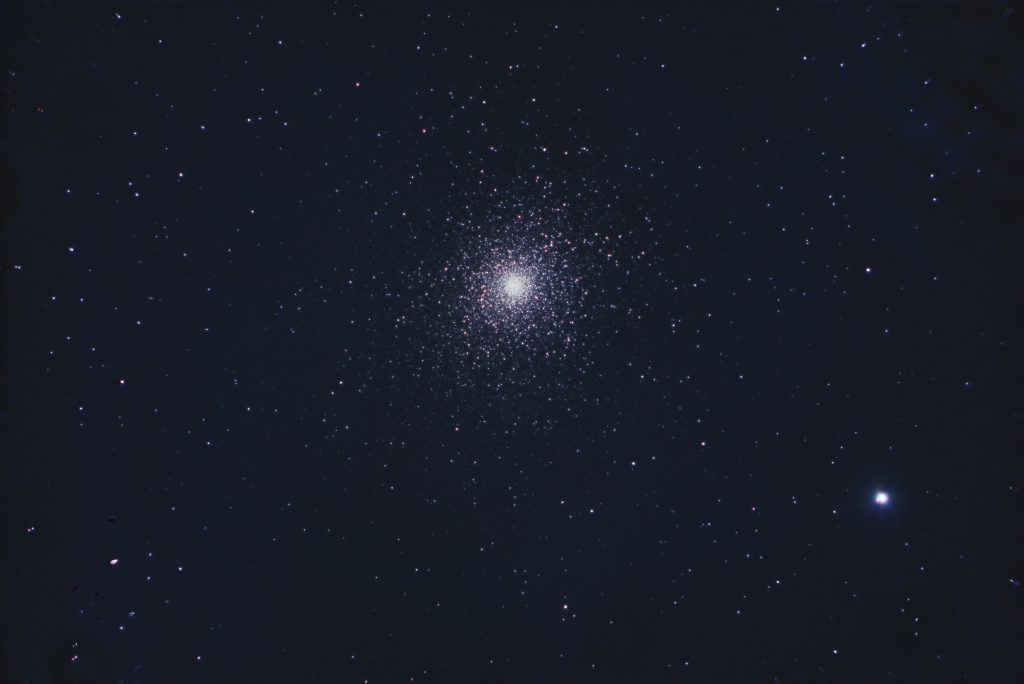
M5 is, under extremely good conditions, just visible to the naked eye as a faint “star” 0.37 of a degree (22′ (arcmin)) north-west of star 5 Serpentis. Binoculars and/or small telescopes resolve the object as non-stellar; larger telescopes will show some individual stars, some of which are as bright as apparent magnitude 10.6. M5 was discovered by German astronomer Gottfried Kirch in 1702 when he was observing a comet. Charles Messier noted it in 1764 and—a studier of comets—cast it as one of his nebulae. William Herschel was the first to resolve individual stars in the cluster in 1791, counting roughly 200. Messier 5 is receding from the Solar System at a speed over 50 km/s.
Object Designations: M5, Messier 5
Also known as: (none)
Constellation: Serpens
Object Type: star cluster
Distance: 24,500 light-years away
Magnitude: 5.6
Discovery: Gottfried Kirch
Telescope: Celestron 9.25 SCT with Starzona .63 corrector 1500 mm / f7
Camera: ZWO ASI2600 MC Pro – Antlia RGB Ultra Filter
Mount: Celestron CGEMII – With CPWI Software
Guiding: Celestron StarSense Autoguider
SharpCap Imaging Software
Processing Software
AstroSharp Ltd SharpCap
Pleiades Astrophoto PixInsight
GraXpert
Russell Croman Astrophotography BlurXTerminator
Russell Croman Astrophotography NoiseXTerminator
Russell Croman Astrophotography StarXTerminator
Various scripts
This final image is:
20 – 120 second subs at 100 gain, no filter
White Bal (B) = 49
White Bal (R )= 86
Brightness = 24
Camera Temperature = -9.8
LastPlateSolveData=Plate solve result was RA=15:23:11.7,Dec=+01:36:30 with mount at RA=15:23:16.0,Dec=+01:36:29, FOV 0.902×0.603 degrees, up is 269.19 degrees East of North