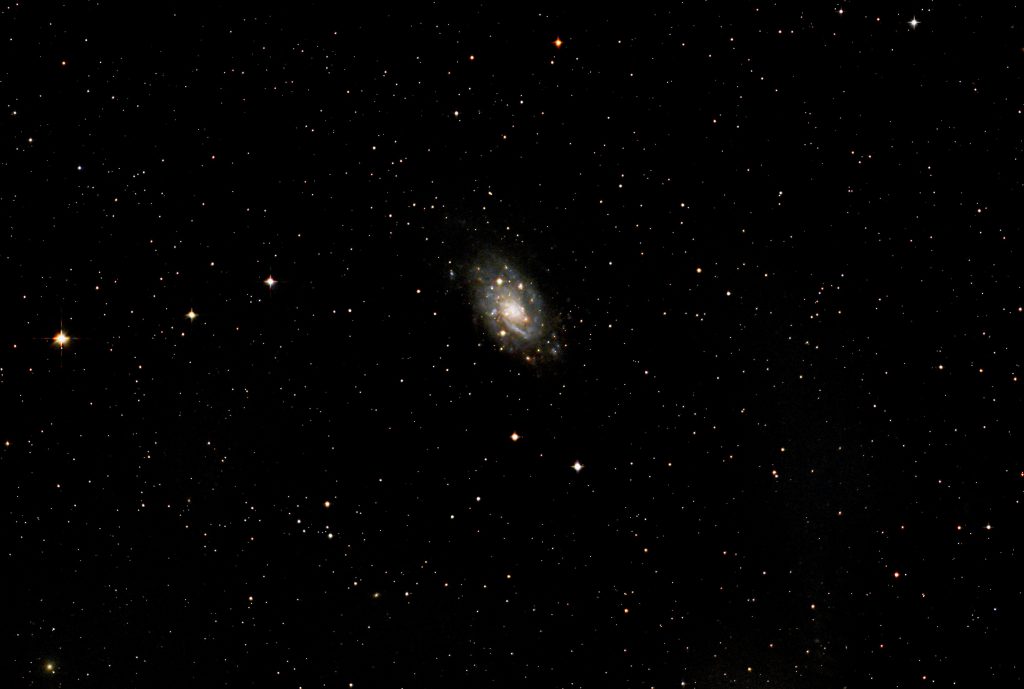
NGC 2403 is an intermediate spiral galaxy in the constellation Camelopardalis. It is an outlying member of the M81 Group, and is approximately 9.7 million light-years distant. The galaxy was discovered by German-British astronomer William Herschel in 1788. Edwin Hubble detected Cepheid variables in NGC 2403 using the Hale Telescope, making it the first galaxy beyond the Local Group within which a Cepheid was discovered. By 1963, 59 variables had been found in NGC 2403, of which 17 were eventually confirmed as Cepheids, with periods between 20 and 87 days. As late as 1950 Hubble was using a distance of just under 2 million light years for the galaxy’s distance, but by 1968 the analysis of the Cepheids increased this by almost a factor of five, to within 0.2 magnitudes of the current value.
Object Designations: NGC4403
Also known as: (none)
Constellation: Camelopardalis
Object Type: spiral galaxy
Distance: 9.6 million light-years away
Magnitude: 8.9
Discovery: William Herschel
Telescope: Apertura CarbonStar 200 Imaging Newtonian 800mm / F4
Camera: ZWO ASI2600 MC Pro – No Filter
Mount: Celestron AVX – With CPWI Software
Guiding: Apertura 32mm Guide Scope with a ZWO ASI120MM Camera and PHD2
SharpCap Imaging Software
Processing Software
AstroSharp Ltd SharpCap
Pleiades Astrophoto PixInsight
Russell Croman Astrophotography BlurXTerminator
Russell Croman Astrophotography NoiseXTerminator
Russell Croman Astrophotography StarXTerminator
Stanley Dimant EZ Processing Suite
This final image is:
60 – 75 second subs at 101 gain, no filter
White Bal (B) = 68
White Bal (R )= 99
Brightness = 12
Camera Temperature = -10
LastPlateSolveData=Plate solve result was RA=07:29:36.4,Dec=+69:17:11 with mount at RA=07:29:36.9,Dec=+69:17:11, FOV 1.756×1.174 degrees, up is 89.69